Is Kuala Lumpur safe?
Yes — and here is the detail
Generic reassurance is useless, so this page is specific: which risks are real, where they are concentrated, what solo female travellers actually report, and the two categories most safety pages skip entirely — road safety, and what Black, African and South Asian travellers say about being here.
Kuala Lumpur is a safe city for visitors and violent crime against tourists is rare. The real risks are ordinary and geographic: snatch theft and bag-lifting, concentrated in crowded tourist areas and on quiet streets where a motorcycle can pull alongside; the roads, which are the genuinely underrated danger here; and opportunistic scams, almost all of which you have to opt into. Walk with your bag on the wall side and the strap across your body, use Grab rather than a street taxi, and treat crossing a road as an active task rather than a right of way. Two areas warrant extra care after dark: Jalan Haji Taib in Chow Kit, and the Bukit Bintang back lanes after 02:00. Everything else is normal big-city sense.
What goes wrong here, in order of likelihood
Almost everything that happens to visitors in Kuala Lumpur falls into three categories, and only one of them is a crime against a person.
Snatch theft is the headline risk. The classic version involves a motorcycle pillion taking a bag or phone from a pedestrian and being three streets away before anyone reacts. It is opportunistic rather than targeted, and it is defeated by simple habits: bag on the shoulder away from the road, strap across the body, phone in a pocket rather than in your hand while walking, and no gold on display. The second version is quieter — bags lifted from the back of a chair on a food street or from an unattended table.
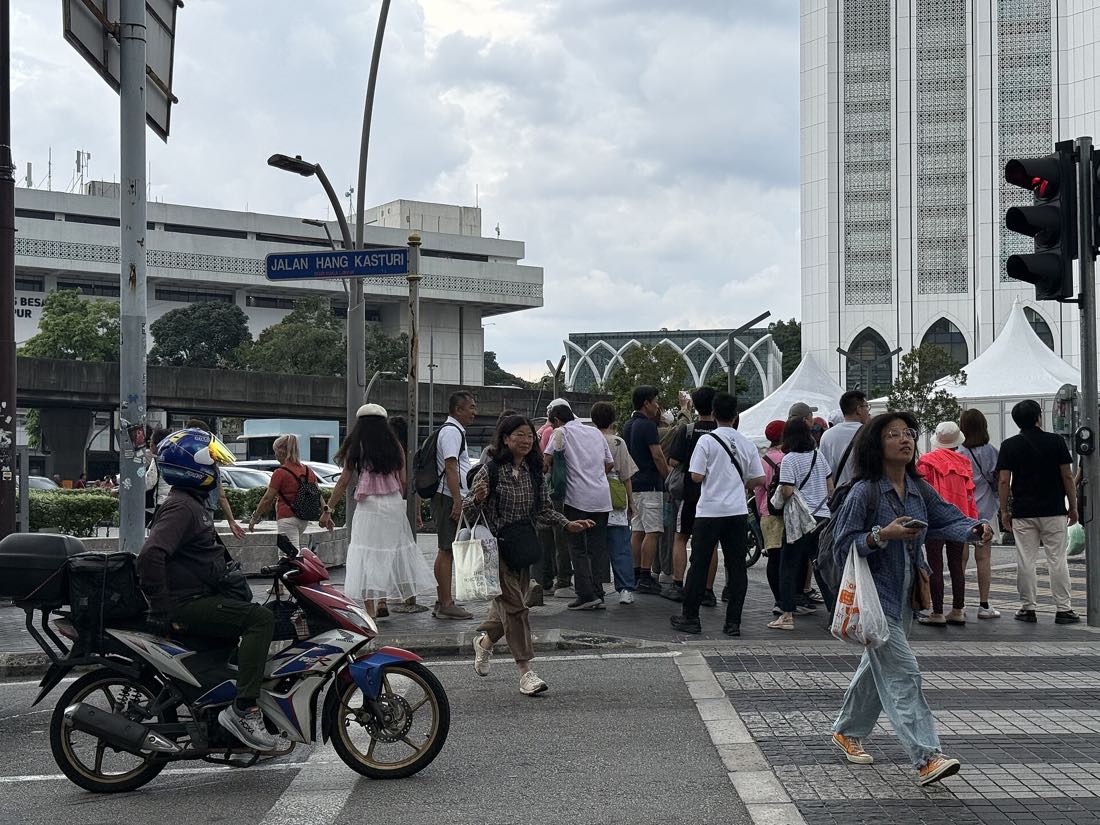
Road safety is the underrated one. Kuala Lumpur was rebuilt around the car, motorcycles filter through everything including pedestrian gaps and pavements, and crossings are often absent where you most want one. Assume a green man is advisory. Assume a motorbike will come from the direction you did not check. Walk the extra 80 metres to a footbridge or an underpass — the pedestrian infrastructure is thin, but where it exists it is safer than a gap in traffic.
Scams are the third category, and almost all of them are opt-in. The unmetered taxi, the “my friend's shop” diversion, the counterfeit goods sold as genuine, the fake arrival-card websites charging US$20–40 for a free government form. None of these are done to you against your will; they require you to agree to something. Kuala Lumpur is a low-scam city by regional standards, and the full list with counter-moves is on our scams page.
What is genuinely rare is violent crime against foreign visitors. Malaysia has strict weapons laws and armed robbery of tourists is not a normal event here. The emergency number is 999, and Tourist Police posts operate in the main visitor districts.
Where to be careful, and where the caution is overdone
Safety in Kuala Lumpur is much more about street and hour than about district. Two places genuinely warrant extra care; several others have reputations that outrun the facts.
Jalan Haji Taib, in Chow Kit. This is the one specific street we would name. Chow Kit as a whole is a working neighbourhood with the best wet market in the city and some of the best-value boutique rooms in KL at RM220–360 — go there, and go in the morning. Jalan Haji Taib and the lanes immediately off it are a different proposition after dark, with a visible sex and drugs trade. Do not book a room on it and do not walk it at 01:00.
The Bukit Bintang back lanes after 02:00. Changkat and the surrounding alleys are fine at 22:00 and thin out into something less pleasant in the small hours, with the usual mix of very drunk people, aggressive touts and pickpockets working the stragglers. It is not dangerous so much as it is where trouble is most likely to find a distracted visitor. Take a Grab from the door rather than walking to the monorail.
Reputations that are overdone: Petaling Street is a mediocre market, not a dangerous one — crowded and full of counterfeits, so watch your pockets, but that is the extent of it. Brickfields is a busy Indian quarter that some guides code as unsafe and is not. Kampung Baru is a conservative residential village where the correct behaviour is modest dress, not caution.
One practical note that is about neither crime nor safety: “near LRT” in Ampang or Bangsar routinely means a 25-minute uphill walk on a road with no pavement. Late at night, that walk is the real risk in the booking, and it is invisible on the listing. Check the walking layer on a map before you book — our where to stay page covers it area by area.
What women actually report
Kuala Lumpur is widely reported as one of the more comfortable major Southeast Asian cities for solo female travellers, with the usual late-night caveats and one practical convenience most cities do not offer.
The consistent picture in first-hand accounts is of a city where street harassment is comparatively low, staring is more common than approach, and public transport feels safe. The MRT and LRT run women-only carriages at the front of trains, and KTM Komuter runs women-only coaches — clearly marked in pink, and used. Grab shows the driver, the plate and a fixed price before you get in, which removes most of the negotiation and route anxiety that street taxis create.
The caveats are the ordinary ones and they are about hours rather than places: the Bukit Bintang back lanes after 02:00, empty streets in any district late at night, and walking rather than taking a RM10 Grab because the map says it is only fifteen minutes. Drink-spiking is not a widely reported problem here but the standard precautions cost nothing.
On dress: there is no legal requirement for visitors to cover up, and shorts and vests are unremarkable in Bukit Bintang, KLCC and Bangsar. In more conservative areas — Kampung Baru, Chow Kit, wet markets — shoulders and knees covered attracts less attention and is simply easier. At mosques, robes are provided free, so you do not need to plan around it. The rules page has the detail.
Racism, and who reports experiencing it
We would rather carry this honestly than leave a gap where a reader has to find out for themselves. This section describes what travellers report; it is not a legal summary and it is not a verdict on Malaysia.
Black, African and South Asian travellers report hostility in first-hand accounts more often than white and East Asian visitors do. The reported experiences range from the mild and deniable — being followed in shops, ignored at counters, refused entry to bars on unexplained grounds — to the more direct, including harder questioning at immigration, difficulty securing short-term rentals, and taxi drivers declining fares. Reports from African travellers and from South Asian visitors who are read as migrant workers rather than tourists are the most consistent.
Context matters without excusing anything. Malaysia has a very large migrant workforce from South Asia, Indonesia, Myanmar and parts of Africa, and much of the reported hostility appears to be class and immigration-status prejudice attaching itself to appearance. It is also not universal: many travellers in the same groups report entirely uneventful, warm visits, and Malaysia is itself a multi-ethnic country with large Indian and Chinese populations who are Malaysian, not foreign.
The practical upshot, offered without drama: if you are likely to be read this way, expect that officialdom may be slower with you than with the person in front of you in the queue, carry your documents, book accommodation through platforms with a paper trail rather than informal arrangements, and use Grab, where the fare and the driver are locked in before pickup and there is a complaints record. None of this should stop anyone visiting. It is the kind of thing worth knowing in advance rather than discovering at 23:00 in an airport queue.
The legal position, factually
This needs to be stated plainly rather than softened, because the gap between the law on paper and the day-to-day experience of visitors is wide and both halves matter.
Section 377A of the Malaysian Penal Code applies to everyone, with penalties of up to 20 years. There is no legal recognition of same-sex relationships, and there are no anti-discrimination protections on grounds of sexual orientation or gender identity. Grindr and Blued were blocked in Malaysia in February 2026. Malaysia's legal system also has a syariah track that applies to Muslims only and never to tourists; that distinction is covered on the rules page.
In practice, prosecutions of foreign tourists are rare, and queer travellers routinely report uneventful visits. Kuala Lumpur has a quiet, real scene that operates without signage and without publicity. Hotels do not question two people sharing a room. What is not advisable is public affection, which is discouraged for everyone here regardless of orientation and draws attention when it is not heterosexual, and any assumption that dating apps will work.
The honest summary: the law is severe on paper, enforcement against visitors is uncommon, discretion is the operating norm for local LGBTQ Malaysians and travellers alike, and you should make that trade-off with the facts in front of you rather than a reassurance or a warning.
Three things worth arranging before you land
None of these are safety theatre. Each removes a specific, common failure mode — a bad taxi negotiation, a phone with no data at the wrong moment, and a hospital bill in a country where private healthcare is excellent and not free.
Kuala Lumpur safety FAQ
Is Kuala Lumpur safe for tourists?
Yes. Violent crime against visitors is rare and the real risks are snatch theft, bag-lifting and the roads. Keep your bag on the wall side with the strap across your body, use Grab rather than street taxis, and treat every crossing as an active task. The emergency number is 999.
Is Kuala Lumpur safe for solo female travellers?
It is widely reported as one of the more comfortable major cities in Southeast Asia for solo women, with low street harassment, women-only carriages at the front of MRT and LRT trains, and Grab fixing the driver and fare before pickup. The caveats are about hours: avoid the Bukit Bintang back lanes after 02:00 and take a car rather than walking late.
Which areas of Kuala Lumpur should I avoid?
Jalan Haji Taib in Chow Kit after dark, and the Bukit Bintang back lanes after 02:00. Chow Kit itself is worth visiting in the morning for the wet market, and Petaling Street is a mediocre market rather than a dangerous one. Most reputational warnings about Brickfields and Kampung Baru are overdone.
Is Kuala Lumpur safe at night?
Broadly yes, and the night is when the city is at its best — the fountains at 19:30, food streets from 19:30, mamaks at 02:00. Stick to lit, busy streets, keep your phone out of your hand while walking, and take a Grab home rather than a 25-minute walk. See KL at night.
Is Grab safe in Kuala Lumpur?
Yes, and it is the correct default. The driver, the vehicle, the plate and the fare are all fixed before you get in, which removes the single most common tourist problem here — the unmetered taxi. It is also cheap. Full detail on our scams page.
Is Malaysia safe for LGBTQ travellers?
Section 377A applies to everyone with penalties of up to 20 years, there are no anti-discrimination protections, and Grindr and Blued were blocked in February 2026. Prosecutions of tourists are rare and queer travellers routinely report uneventful visits, but discretion is the operating norm and public affection is not advisable.
Do people experience racism in Kuala Lumpur?
Black, African and South Asian travellers report hostility in first-hand accounts more often than other visitors — ranging from being ignored or followed in shops to harder immigration questioning and refused bookings. Many travellers in the same groups report entirely warm visits. Carry documents, book through platforms with a record, and use Grab.
What should I do if something is stolen in Kuala Lumpur?
Call 999 or go to the nearest police station and file a report — you will need it for any insurance claim, and Tourist Police posts operate in the main visitor districts. Cancel cards immediately; card skimming exists here, which is why we suggest paying contactless or by e-wallet rather than handing a card over.