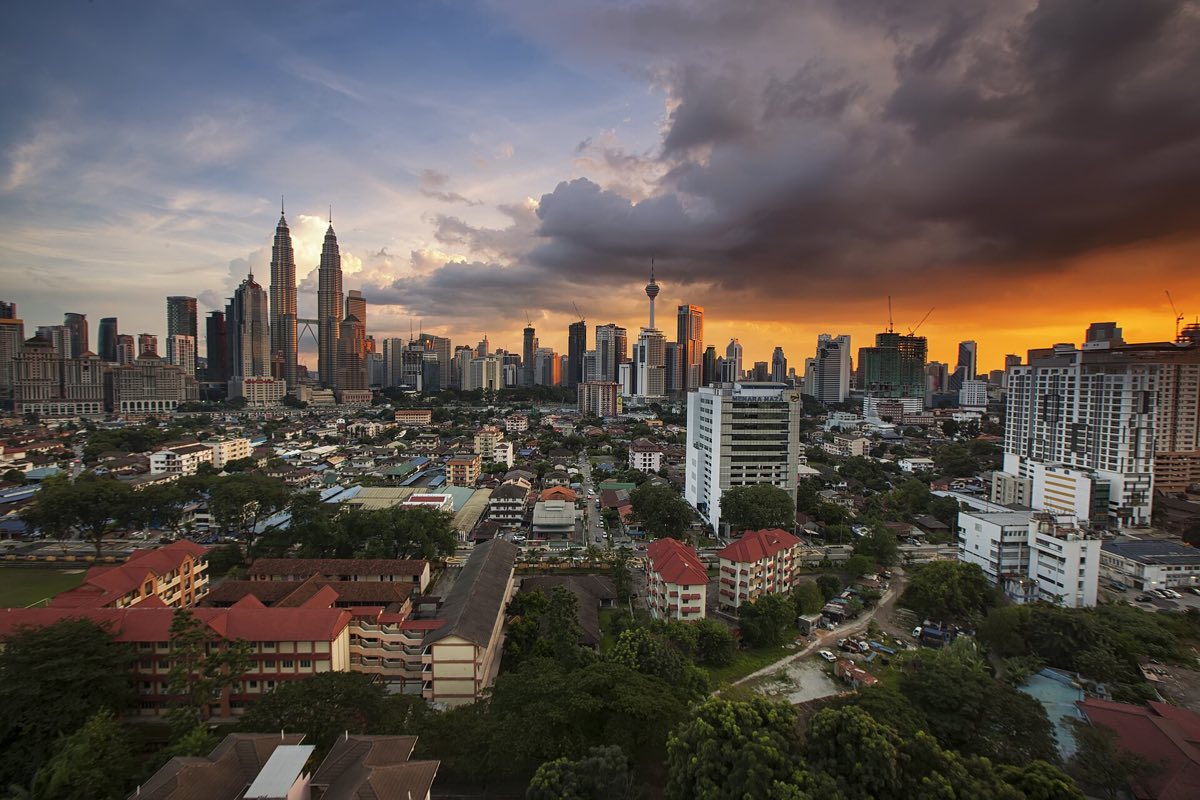
Is Kuala Lumpur
worth visiting?
Kuala Lumpur has spent two decades as the city people connect through. That is now measurably out of date, and the guidebooks have not caught up. Below is the strongest honest version of the case — with the arrivals data, the currency, the food and the rail — followed by the counter-case, which is real and which most sites will not print.
Yes, and give it three days rather than two. Kuala Lumpur is the cheapest genuinely first-world-functional big city in Asia: a working rail network, near-universal English, a world-class airport, Michelin stars, and a plate of some of the best food on earth for two dollars. Malaysia recorded 42.2 million visitors in 2025, up 11.2%, the most in Southeast Asia. We are going to spoil our own headline, because the number is not what most sites think it is: that is Tourism Malaysia's visitor series — its own infographics head it “Tourist + Excursionist” — and 15.6 million of it never stayed a night, about half of them Singaporeans crossing the Johor causeway. Thailand's 32.9 million counts overnight tourists only. Compare like with like and Thailand is still ahead, roughly 33.0 million to Malaysia's 26.6 million. Malaysia leading the region on total visitors is real and worth knowing; “Malaysia overtook Thailand” is a measurement switch, and you will see it repeated everywhere including by fact-checks that flagged the problem in the same article. KL itself grew 73% year on year to 17.5 million arrivals in 2024, the fastest-growing top-ten city destination on earth. The counter-case is equally real: it is 32°C every day, it storms most afternoons, the city was rebuilt around the car and the pavements are broken — and a badly scheduled 48 hours here genuinely is boring. That is a solvable problem and we have a whole page on solving it.
Four figures that have changed the argument
None of these were true the last time most guidebooks were revised, which is the single best reason to re-examine a city you have already written off.
Why Kuala Lumpur is a better trip than its reputation
The strongest argument for KL is not any single sight. It is that almost nothing here is difficult, and the things that are cheap are genuinely excellent rather than merely affordable.
It works. MRT, LRT, monorail and KTM Komuter reach essentially everything on a visitor's list; Prasarana moved a record 1.54 million journeys on New Year's Eve 2025/26. KLIA is a world-class airport with a 28-minute express train to the centre for RM55. English is close to universal. Tap water plumbing, hospitals, mobile data and card payments all behave the way you expect. That combination — functional infrastructure at Southeast Asian prices — does not exist in many places.
The food is a top-three-in-the-world argument, not a nice-to-have. Three culinary traditions layered on the same street, at RM8–15 a plate. The 2026 Michelin guide put both of KL's brand-new stars — Akar and Terra Dining — in TTDI, a suburb no guidebook mentions, and both new Bib Gourmands, Gulainya and Lama, are Peranakan. Around 25 of Malaysia's 58 Bib Gourmands are in KL. And the best meal you will eat may well be RM10.50 of chilli pan mee at Kin Kin, 40 Jalan Dewan Sultan Sulaiman 1, Chow Kit, 07:00–19:00.
It is the cheapest functional big city in Asia. At RM 4.06 to the dollar, a solid boutique room is around RM210, a five-star room in the centre costs roughly what a mid-range one does in Bangkok, and about 4,600 new rooms land between 2026 and 2028 on a 70,000-room base, some 60% of them luxury — supply that will push real prices down further. Inflation is running at 1.9% nationally, 2.2% in KL.
The good things are largely free or nearly free. The best museum in the country is RM20, the same for everyone. Royal Selangor — TripAdvisor's #2 KL attraction at 4.7/5 from 5,142 reviews — is free with a free shuttle. Batu Caves is RM2.60 by train and free at the top. Rainforest canopy is RM5. Fifteen more are on our free things page.
And the city is visibly changing. Merdeka 118 has pulled the centre of gravity back south for the first time in twenty years; 118 Mall opens in August 2026 with 300-plus outlets; Chinatown's lorongs have become the most interesting quarter in the city. Chinese arrivals were up 25.2% in Q1 2026 with visa-free entry running through the end of the year. Whatever you were told about KL in 2019 is describing a different place.
The four honest reasons people leave disappointed
We would rather you arrive with these in mind than discover them on day two. All four are real; three are manageable and one is not.
The heat and the humidity are relentless. Around 32°C every day of the year, with humidity that makes walking between sights at 14:00 genuinely unpleasant rather than merely warm. There is no cool season to wait for. If you cannot adjust your day around it, you will not enjoy this city.
It storms most afternoons. Between 16:00 and 18:00, hardest in April–May and October–November, usually clearing by 19:00–20:00. This is not bad luck, it is the climate — and a plan that ignores it loses two hours a day. Our rainy day page treats it as a timetable rather than a contingency, which is the correct framing.
The city was rebuilt around the car. KL was largely remade in the 1980s and 90s around private vehicles and air-conditioned malls, and the pedestrian layer suffered for it: broken pavements, missing crossings, footbridges that end at a wall. Anything sold as “near LRT” in Bangsar or Ampang routinely means a 25-minute uphill walk with nowhere to walk. Rail plus Grab solves most of this; nothing solves all of it.
And a badly scheduled 48 hours is genuinely boring. This is the honest one. KL's social life happens indoors, after dark, or both — so a visitor doing daytime sightseeing on a European clock, eating dinner at 19:00 and returning to a hotel in a mall district at 21:00 will conclude there is nothing here. They are not lying. They found a real thing. They just found it in the wrong hours, and we take that complaint apart properly on is KL boring.
Three days, and what each one is for
Two days is the number that produces the bad reviews. Three is the number that produces the good ones, and the reason is structural rather than a matter of taste.
Two days in Kuala Lumpur means two blocks of daylight sightseeing, because a 48-hour visitor rarely trusts the city enough to be out at 23:00 on the first night. That schedule collects the towers, a mall, a temple and a wet afternoon — which is precisely the itinerary that produces “there is nothing to do here”.
Three days changes the shape. Day one is the old core: Chinatown's lorongs, Merdeka Square, Masjid Negara, the Islamic Arts Museum through the storm, and a food tour at night. Day two is the new core plus height: Batu Caves at 07:30, an indoor midday, Petronas at the sunset slot, then the fountains and Kampung Baru. Day three is a day trip — Ipoh by ETS train is the best one and DIY beats every tour on it.
Five days lets you add Melaka or the Kuala Selangor fireflies and still have an unplanned day, which in this city is a genuinely good use of time. The full plans are on our 3-day and 5-day itineraries.
The three things to sort first
Almost nothing in Kuala Lumpur needs booking ahead, which is itself an argument for going. These are the exceptions, in order of how much regret they prevent.
Is Kuala Lumpur worth visiting FAQ
Is Kuala Lumpur worth visiting in 2026?
Yes, for about 72 hours. It is the cheapest genuinely functional big city in Asia — working rail, near-universal English, world-class airport, Michelin stars and RM8–15 hawker plates. Malaysia recorded 42.2 million visitors in 2025, up 11.2%, the most in Southeast Asia — but that series counts same-day visitors, 15.6 million of them, and Thailand's 32.9 million counts overnight tourists only. On overnight tourists Thailand is still ahead, about 33.0 million to 26.6 million. The city is worth your time either way; the statistic is just less tidy than it is usually printed.
How many days do you need in Kuala Lumpur?
Three. Two days produces the bad reviews, because a 48-hour visitor spends both blocks doing daylight sightseeing and misses the part of the city that happens after 19:00. Three days lets you use the mornings, the indoor afternoons and the nights properly, plus one day trip.
Is Kuala Lumpur better than Bangkok or Singapore?
Different. Bangkok is more chaotic, more famous and now shrinking on arrivals; Singapore is more polished and roughly twice the price. KL is the value proposition — Singapore-adjacent functionality at Bangkok-adjacent prices, with better street food than Singapore and a fraction of Bangkok's crowds.
Is Kuala Lumpur just malls?
That is what a badly scheduled trip finds, and the malls are real — the city was rebuilt around the car and the air-conditioned mall in the 1980s and 90s. But the malls are the shelter, not the destination. Kampung Baru, the Chinatown lorongs, Chow Kit market, the hills and the mamak at 02:00 are the city. See is KL boring.
Is Kuala Lumpur expensive?
No, with one loud exception. Rooms, food and transport are cheap at RM 4.06 to the dollar — a hawker plate is RM8–15 and a solid boutique room around RM210. Alcohol is the exception: excise rose 10% on 1 November 2025 and a pint is RM22–35. Attraction tickets also cost foreigners up to 180% more than Malaysians, which is covered on dual pricing.
Is Kuala Lumpur worth a stopover?
Yes, but know the geometry: KLIA is 55km out and the KLIA Ekspres is 28 minutes from T1, 31 from T2, at RM55 single or RM100 return with 10% off online. Below about five hours you stay airside. Our layover playbook sets out what 5, 8 and 12 hours actually buy.
What is Kuala Lumpur best known for?
The Petronas Twin Towers, Batu Caves and the food — and increasingly Merdeka 118, the world's second-tallest building at 678.9m, which is finished and standing over Chinatown while most rankings have not caught up. The food is the strongest of those claims by a distance.