Chinatown:
skip the market,
stay for the lorongs.
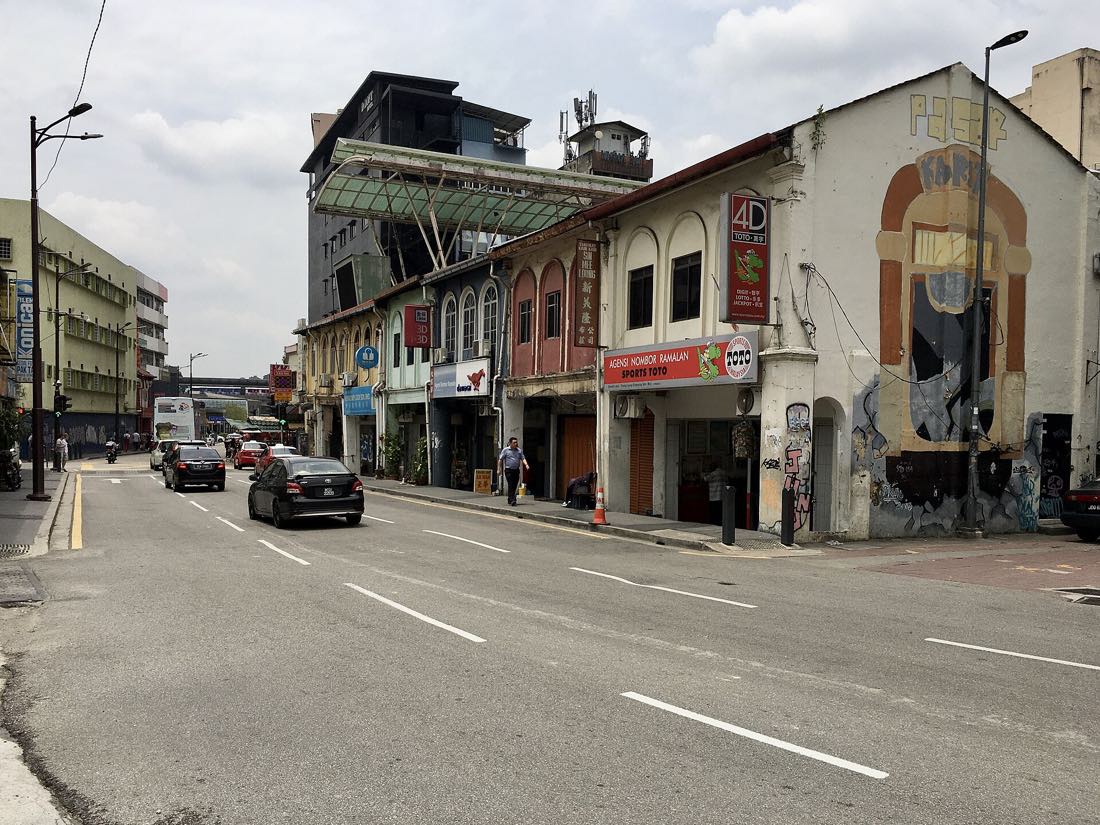
Chinatown is the answer nobody expects and the one that holds up hardest in 2026. Rooms run about RM150, the MRT Kajang line stops at Pasar Seni, Merdeka 118 and its own MRT station now sit at the edge of the quarter, and the streets have been quietly transformed. But you have to make one split that almost nobody makes: Petaling Street’s covered market rates 3.6 out of 5 across 11,733 TripAdvisor reviews and is a straightforward skip — counterfeit handbags under a green roof, sold hard. The lorongs running off it — Kwai Chai Hong, Lorong Panggung, REXKL — plus three of the city’s oldest temples are among the best things in Kuala Lumpur, and they are free. Same 400 metres, opposite verdicts.
Petaling Street is not Chinatown
The covered market is a skip and the streets around it are excellent, and conflating the two is why Chinatown has a worse reputation than it deserves. Here is the line between them.
The covered market is the 200-metre stretch of Jalan Petaling under the green roof, and it scores 3.6 out of 5 across 11,733 TripAdvisor reviews — the largest single pool of disappointment in Kuala Lumpur. It sells counterfeit watches, bags and shirts, with hard-sell touting and prices that start at three or four times what anyone pays. There is nothing there you want, and no amount of haggling changes that. Walk through it in four minutes, note that you have now seen it, and move on. Central Market, ten minutes west, does slightly better at 3.9/5 and at least sells things made in Malaysia.
The lorongs — the back lanes and side streets — are a different city. Kwai Chai Hong is a restored alley off Lorong Panggung with murals telling the story of the 1960s neighbourhood, a red-lantern bridge and a row of bars and cafés in the shophouses behind it. Lorong Panggung itself is the narrow blue-walled lane that everybody photographs. REXKL is a burned-out 1940s cinema rebuilt as a bookshop, food hall and gallery, and it is the single best piece of adaptive reuse in the country.
The temples are the third layer, and they are the oldest thing in the quarter. Sin Sze Si Ya, founded in 1864, is the oldest Taoist temple in Kuala Lumpur, built by Kapitan Yap Ah Loy and tucked behind a shopfront on Lebuh Pudu — most visitors walk past the entrance. Guan Di on Jalan Tun H S Lee has the 59kg copper guandao that people queue to lift for luck. Sri Maha Mariamman, a few doors along, is the city’s oldest Hindu temple and the departure point of the Thaipusam procession to Batu Caves. All three are free, all three are active, and all three are within 300 metres of the market you are skipping.
What has changed since 2024 is the edge of the quarter. Merdeka 118 — 678.9m, the world’s second-tallest building — now stands over Chinatown’s southern boundary, with an MRT Putrajaya line station underneath it and a seven-storey mall opening in August 2026. For two decades Kuala Lumpur drifted north-east toward KLCC. It is snapping back, and Chinatown is where that lands.
Chinatown, ranked
Kwai Chai Hong and Lorong Panggung
A restored back alley off Lorong Panggung with murals of 1960s Chinatown life, a red-lantern bridge and a strip of bars behind it. Go in the late afternoon when the light is low and the lanterns are on but the bar crowd has not arrived. The whole thing takes 30 minutes and costs nothing.
REXKL
A burned-out cinema on Jalan Sultan rebuilt into a bookshop, food hall, gallery and event space, with the original raked floor and shell left visible. The best storm shelter in the old city and the clearest evidence that the Chinatown revival is real rather than marketed.
Sin Sze Si Ya, Guan Di and Sri Maha Mariamman
Sin Sze Si Ya from 1864 is the oldest Taoist temple in KL and hides behind a shopfront on Lebuh Pudu. Guan Di has the 59kg copper blade visitors lift for luck. Sri Maha Mariamman is the city’s oldest Hindu temple and the start of the Thaipusam procession. Remove shoes where indicated, cover shoulders, ask before photographing worshippers.
Madras Lane curry laksa
An alley of hawker stalls behind the market where the curry laksa is one of the ten dishes worth planning a day around. The window is narrow and unforgiving: 07:30 to 11:30, closed Sunday and Monday. Arrive before 10:00 or accept that the good stalls have sold out.
Kim Lian Kee Hokkien mee
The only one of KL’s ten defining dishes that was invented in Kuala Lumpur, at this address, in 1927 — thick noodles in black soy with pork lard and prawns, cooked over a charcoal wok. About RM18, evenings only, 18:00 to midnight. It is 40 metres from the covered market and worlds away from it.
The Petaling Street covered market
The largest pool of disappointment in the city, and the reason people write off a quarter that deserves better. Counterfeit goods, hard touting and opening prices at three to four times the real one. Four minutes to walk through, and there is no version of it that repays longer.
Chinatown, practically
Where to stay in Chinatown
The shophouse conversions on Jalan Sultan, Jalan Petaling and the lanes off Lebuh Pudu are the reason this area has stopped being a backpacker default and started being a design one. Ask for a room off the main lane if you are a light sleeper.
A free Chinatown afternoon against a booked one
Nothing in this quarter charges admission. That makes the tour-versus-DIY question unusually clean here, and it is the reason we rate Chinatown as the best-value base in the city.
Four hours covering three temples, the restored lorongs, the best adaptive reuse project in Malaysia and the only one of Kuala Lumpur’s ten defining dishes that was invented in Kuala Lumpur — at the address where it was invented, in 1927.
Three to four hours and 10–12 tastings with a guide. The good ones are genuinely good and cover this quarter properly. The spread is the point: the same duration and roughly the same route varies by a factor of four between operators.
Compare food toursVerdict. Do it yourself for the sights and consider a tour only for the food. Every temple, lane and mural in Chinatown is free and self-guided in an afternoon, so a general walking tour here is buying you narration at a fair price and access at no price. A food tour is the one that can earn its money — the guide gets you past the language barrier at stalls that do not want to explain themselves — but compare at least three listings, because US$39 and US$180 buy the same three hours.
KL Chinatown FAQ
Is Chinatown a good place to stay in Kuala Lumpur?
It is the best-value base in the city. Rooms run around RM150, the MRT Kajang line stops at Pasar Seni, Merdeka 118 and its own MRT station sit at the edge of the quarter, and you can walk to Merdeka Square, Central Market and the temples. The catch is that Petaling Street’s covered market is on your doorstep and it is a skip.
Is Petaling Street worth visiting?
The covered market is not. It rates 3.6 out of 5 across 11,733 TripAdvisor reviews — the largest pool of disappointment in Kuala Lumpur — and sells counterfeit goods with hard touting at three to four times the real price. The lanes around it are excellent and free. Walk the market in four minutes and spend the afternoon on the lorongs.
What is Kwai Chai Hong?
A restored back alley off Lorong Panggung, painted with murals of 1960s Chinatown life and hung with red lanterns, with bars and cafés in the shophouses behind. It is free, it takes about 30 minutes, and late afternoon is the right light. It is the clearest single example of how much this quarter has changed.
Where do you eat in KL Chinatown?
Madras Lane, off 69 Jalan Petaling, for curry laksa between 07:30 and 11:30 — closed Sunday and Monday. Kim Lian Kee at 42/92 Jalan Hang Lekir for KL Hokkien mee, 18:00 to midnight, about RM18. That dish was invented at that address in 1927 and is the only one of the city’s ten defining plates that originated here.
Which station is KL Chinatown?
Pasar Seni, on the MRT Kajang line and the LRT Kelana Jaya line, at the western edge of the quarter beside Central Market. Merdeka station on the MRT Putrajaya line sits under Merdeka 118 at the southern edge and is often the better exit if your hotel is on Jalan Sultan.
Is Chinatown safe at night in Kuala Lumpur?
Yes, with normal city caution. The main lanes are busy and lit until late, and the usual issues are pickpocketing in the market crush and persistent touting rather than anything worse. Our safety page covers what travellers actually report across the city.
Is Merdeka 118 in Chinatown?
It stands at Chinatown’s southern edge, about a ten-minute walk from Petaling Street, over Stadium Merdeka. The tower is 678.9m and the second-tallest building in the world. Whether its observation deck is selling public tickets is unresolved as of August 2026 — do not pre-book a ticket that will not show you a price.
Related tickets, tours and stays
Deep links to specific products for the places on this page. Prices and availability are shown by each provider.