The Kuala Lumpur rules
that catch people out
Malaysia is an easy country to travel in and a bad country to be careless in. This page states the law as it stands in August 2026, without softening it and without dramatising it, and it flags the one area that is changing fast enough that you should check the current position yourself before you fly.
Three things matter more than everything else on this page. One: Malaysia still has a death penalty for drug trafficking. The mandatory one was abolished in July 2023 and a discretionary death penalty remains, with an alternative of 30–40 years plus at least 12 strokes of the cane. Cannabis and CBD are included and police can urine-test for consumption that happened abroad. Nothing has been decriminalised. Two: vape law varies by state and is the fastest-moving legal risk in the country — several states have moved to ban sales outright and the position keeps changing, so check the current status for the states you are entering rather than relying on any page, including this one. Three: the MDAC is free and required within three days of arrival, at imigresen-online.imi.gov.my/mdac/main. Everything else is etiquette and timing.
What actually applies to you as a visitor
Malaysia abolished the mandatory death penalty for trafficking in July 2023 but kept a discretionary one, with an alternative of 30–40 years and at least 12 strokes of the cane. Cannabis and CBD are included. Nothing has been decriminalised — do not let anyone tell you otherwise.
Malaysia abolished the mandatory death penalty for trafficking in July 2023 but retained a discretionary death penalty, with an alternative sentence of 30 to 40 years' imprisonment plus at least 12 strokes of the cane. Quantity thresholds create a presumption of trafficking, so possession of a modest amount can be charged as trafficking. Cannabis and CBD products are included — a legal purchase in your home country is illegal here, and that applies to gummies, oils and vape liquids as much as to plant material. Police can and do conduct urine tests for consumption, including consumption that took place abroad before you arrived. Do not carry anything for anyone, and do not assume a prescription travels.
Discretionary death penalty; alternative 30–40 years plus ≥12 strokesVape law in Malaysia varies by state and is changing quickly. Several states have moved to prohibit the sale of vape products outright, others regulate them, and the national framework has been repeatedly revised. Because the picture differs across state lines and can change between you booking and you arriving, check the current status for the specific states you will be in before you travel — do not rely on a blog, a shop assistant or this page. Nicotine liquids are regulated separately from devices in some formulations, and anything containing cannabinoids falls under the drugs law above, where the penalties are severe.
Varies by state — verify before you flyAlcohol is legal in Malaysia and widely available in bars, hotels and non-halal restaurants. It is not sold to Muslims, which is a restriction on Malaysian Muslims under state law rather than on you, and nobody will comment on what a visitor orders. What will surprise you is the price: excise rose 10% on 1 November 2025 to RM192.50 per litre of pure alcohol — the first rise since 2016 — and tax is 40–60% of retail, so a pint is RM22–35. Drinking in public and visible drunkenness are not normal behaviour here. The legal drinking age is 21.
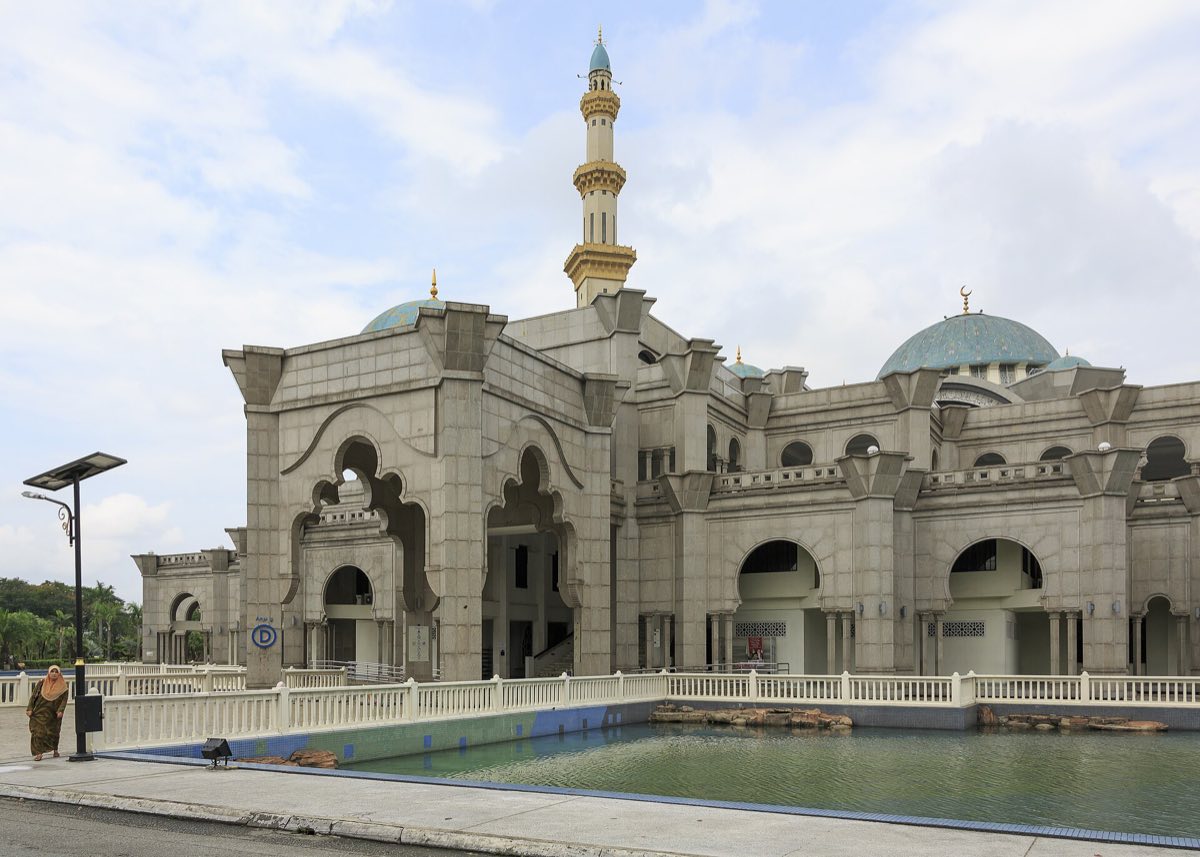
Pint RM22–35 · cocktail RM45–90Masjid Negara, Masjid Jamek and Masjid Wilayah all welcome non-Muslim visitors outside prayer times and provide robes free of charge, so there is nothing to plan around on dress. Remove your shoes, do not walk in front of anyone praying, do not enter the prayer hall proper unless invited, and ask before photographing people. Published visiting hours for the main mosques are inconsistent across sources, so treat the prayer schedule as the real constraint and turn up outside it. The same courtesy applies at Chinese temples and at Batu Caves, where sarong hire is RM5–10 if your knees are showing.
Robes provided free · closed to visitors at prayer timesOn Fridays, Friday prayers stop a large part of Malay-majority working life for roughly 12:15 to 14:45. Government offices close, many Malay-owned businesses shut, mosques are closed to visitors, and traffic around them is heavy either side. It is not a public holiday and the malls, trains and Chinese and Indian businesses all keep running — but if you plan a mosque visit, a government errand or a Kampung Baru walk into that window, it will not work. Note separately that the FRIM Forest SkyWalk closes on Fridays, and Friday closures are also reported at KL Forest Eco Park.
Plan around 12:15–14:45 on FridaysDuring Ramadan, Malaysian Muslims fast from dawn to sunset. Non-Muslims are under no obligation to fast and restaurants stay open, but eating, drinking and smoking conspicuously in the street during daylight is discouraged and reads as rude. Museum hours shift — the Islamic Arts Museum closes at 17:00 during Ramadan rather than 18:00. The upside is the Ramadan bazaars, which are the best street-food events of the year. Skip the hotel Ramadan buffets at RM160–320 when the bazaar outside is doing the same food for about RM20.
Bazaar RM20 vs hotel buffet RM160–320Malaysia treats speech touching race, religion and royalty — the “3R” — as legally constrained rather than merely sensitive, under the Sedition Act, the Communications and Multimedia Act and related provisions. Prosecutions of Malaysians for social-media posts are not unusual. Two structures underlie this and are worth understanding factually. The Bumiputera framework provides constitutional preferences in areas including education, public-sector employment and property for Malays and indigenous peoples; it is a live domestic political question and not a visitor's argument to have. The legal system also runs a dual track: civil courts for everyone, and syariah courts which handle personal and family matters for Muslims. Syariah courts bind Muslims only and never apply to tourists. The practical advice is simple: this is a country where these subjects are discussed carefully in public, and a visitor posting strong opinions about them is taking a legal risk for no benefit.
Sedition and communications offences carry custodial penaltiesSection 377A of the Penal Code applies to everyone, with penalties of up to 20 years. There is no legal recognition of same-sex relationships and no anti-discrimination protection on grounds of orientation or gender identity. Grindr and Blued were blocked in Malaysia in February 2026. In practice, prosecutions of foreign tourists are rare, hotels do not question two people sharing a room, and queer travellers routinely report uneventful visits. Public affection is discouraged for everyone here and attracts more attention when it is not heterosexual. Discretion is the operating norm for local LGBTQ Malaysians and visitors alike; more on is Kuala Lumpur safe.
Section 377A: up to 20 years · prosecutions of tourists rareFlying a drone in Malaysia requires authorisation from the Civil Aviation Authority of Malaysia (CAAM), and applications need roughly 14 working days' lead time. The ceiling is 400 feet, and there is a 150-metre rule around congested areas, buildings and gatherings. Between the KLIA and Subang approach paths, the density of central Kuala Lumpur and the number of protected sites, central KL is effectively unflyable for a tourist. Assume every skyline shot you have seen was either permitted or illegal. Customs can and do inspect drones on arrival.
CAAM authorisation, ~14 working days · 400ft ceiling · 150m ruleThe Malaysia Digital Arrival Card is still required, is free, and must be submitted within three days of arrival at imigresen-online.imi.gov.my/mdac/main. Singapore citizens are exempt. Type the address rather than searching for it: a cluster of lookalike sites charges US$20–40 to file the same free form and often harvests passport data along the way. That is covered in more detail on our scams page.
Free · within 3 days · Singapore citizens exemptUse your right hand to give, receive and eat — the left is considered unclean. Remove shoes when entering a home and most temples. Do not touch anyone's head, including a child's. Dress modestly in Kampung Baru, Chow Kit and at wet markets — shoulders and knees covered — while shorts and vests are unremarkable in Bukit Bintang, KLCC and Bangsar. Public affection is minimal across all communities. Tipping is not expected: restaurants add service charge and SST, and Grab fares are fixed in the app.
No tipping expected · right hand · shoes offHow the dual legal system actually works
The syariah question comes up constantly and is almost always explained badly, so here it is plainly and without a verdict attached.
Malaysia runs two parallel court systems. Civil courts handle criminal and civil law for everyone in the country, including every visitor. Syariah courts handle personal and family matters — marriage, divorce, inheritance, and certain religious offences — for Muslims only. Their jurisdiction is defined by religion, not by nationality or location, and it is set at state level, which is why the detail varies between states.
The practical consequence for a visitor is simple and worth stating clearly: syariah courts do not apply to you. A non-Muslim tourist is not subject to syariah offences, is not tried in a syariah court, and does not need to modify their behaviour to comply with rules that bind Malaysian Muslims — including the ban on alcohol sales to Muslims and the state-level regulations on Muslim dress and conduct.
What does apply to everyone is the civil law: the drugs law described above, Section 377A, and the sedition and communications provisions that make race, religion and royalty legally constrained speech. Those are federal criminal statutes and they make no distinction between a Malaysian and a foreigner.
We are not going to adjudicate any of this. It is a live domestic political conversation in a country that is entitled to have it without a travel site's opinion. What we owe you is an accurate description of what applies to whom, so you can behave sensibly in a place whose legal architecture is genuinely different from most visitors' home countries.
Three things to sort before you fly
None of these are legal advice. They are the arrangements that make the rules above easy to comply with rather than something to worry about at a counter.
Malaysia rules and laws FAQ
Does Malaysia still have the death penalty for drugs?
Yes. The mandatory death penalty for trafficking was abolished in July 2023, but a discretionary death penalty remains, with an alternative of 30 to 40 years plus at least 12 strokes of the cane. Cannabis and CBD are included, and police can urine-test for consumption that took place abroad. Nothing has been decriminalised.
Is CBD legal in Malaysia?
No. CBD products fall under the same drugs framework as cannabis, regardless of whether they were bought legally in your home country. That includes oils, gummies and vape liquids. Do not bring them, and do not assume a prescription or a shop receipt provides any protection.
Can you vape in Malaysia?
Vape law varies by state and is the fastest-moving legal risk in the country — several states have moved to ban sales outright and the framework has been revised repeatedly. Check the current position for the specific states you will be in before you fly rather than relying on any guide, and note that anything containing cannabinoids falls under the drugs law.
Do I need to cover up in Kuala Lumpur?
Not generally. Shorts and vests are unremarkable in Bukit Bintang, KLCC and Bangsar. Cover shoulders and knees in Kampung Baru, Chow Kit and at wet markets, where it simply attracts less attention. At mosques, robes are provided free of charge, so there is nothing to plan for.
Is the Malaysia Digital Arrival Card free?
Yes. It is free, required within three days of arrival, and submitted at imigresen-online.imi.gov.my/mdac/main. Singapore citizens are exempt. Sites charging US$20–40 to file it are not official and frequently harvest passport data as well as the fee.
Can tourists drink alcohol in Malaysia?
Yes. Alcohol is legal and sold in bars, hotels and non-halal restaurants; it is not sold to Muslims, which is a restriction on Malaysian Muslims rather than on visitors. The drinking age is 21. Expect to pay RM22–35 for a pint after the 10% excise rise on 1 November 2025.
Do syariah laws apply to tourists in Malaysia?
No. Syariah courts have jurisdiction over Muslims only, in personal and family matters, and are set at state level. Every visitor is subject to the civil law instead — which includes the drugs statutes, Section 377A and the sedition and communications provisions covering race, religion and royalty.
Can I fly a drone in Kuala Lumpur?
Realistically, no. You need CAAM authorisation with about 14 working days' lead time, the ceiling is 400 feet and there is a 150-metre rule around congested areas and buildings. Between the airport approach paths and the density of the city, central KL is effectively unflyable for a tourist.