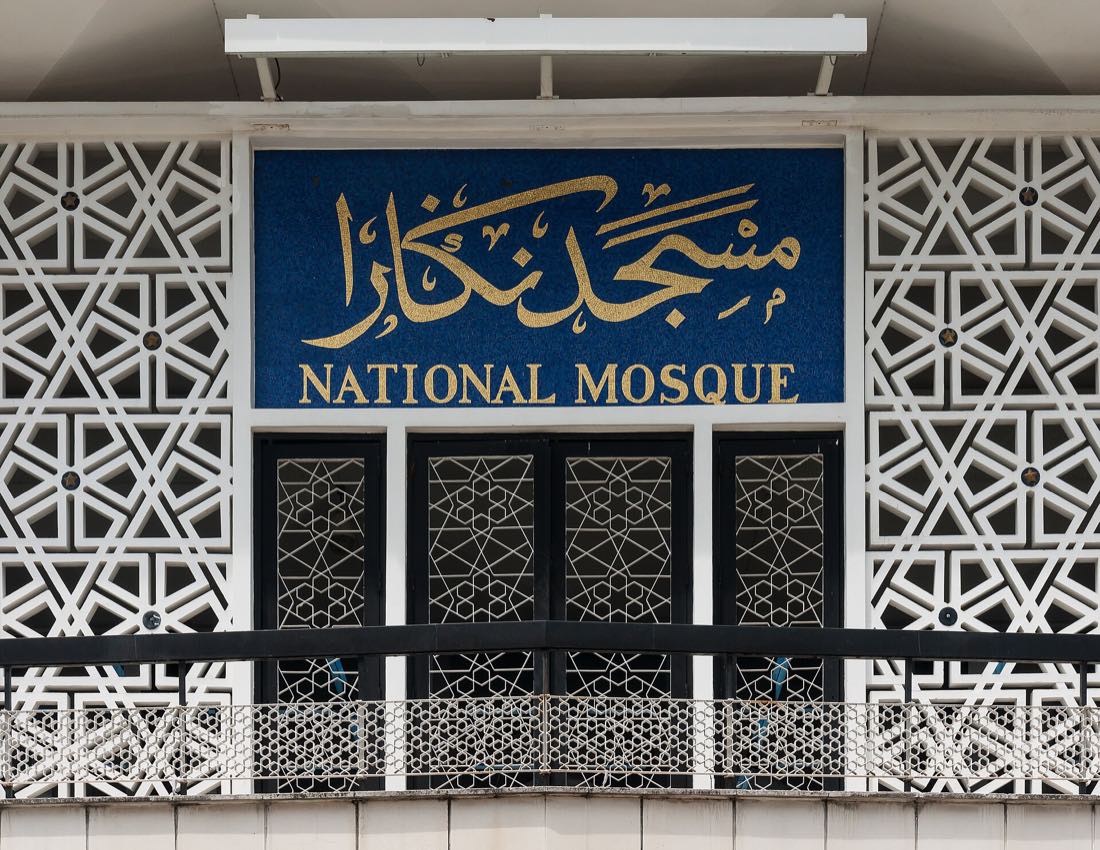
Masjid Negara:
free, and genuinely modern.
A sixteen-point folded-concrete star for a roof, a 73-metre minaret, and not a dome in the traditional sense anywhere on it. Malaysia's National Mosque opened in 1965 as a statement about what an independent country's architecture should look like, and it still reads that way.
Entry is free and robes are provided free at the door for anyone who needs to cover up, which removes the only real barrier most visitors worry about. What you get is the most confident piece of post-independence architecture in Malaysia: a roof folded into a sixteen-point star — one point for each of the thirteen states plus the five pillars of Islam — a 73-metre minaret, reflecting pools, and a main hall that seats around fifteen thousand. It opened in 1965, eight years after independence, and it deliberately looks nothing like a Mughal or Ottoman mosque. On visiting hours we have to be straight with you: we could not verify them. The pattern is consistent and well established — the mosque is closed to non-worshipping visitors during each of the daily prayer times and for Friday prayers — but we found no reliable published clock times and we will not invent any. Turn up mid-morning or mid-afternoon and ask at the reception desk.
Why there are no opening times on this page
Because we could not verify them. Every source we checked gave a different set of clock times for visitor access to Masjid Negara, and a wrong time here costs you a wasted journey — so we are publishing the pattern instead of a number.
The pattern is not in doubt. Masjid Negara is an active mosque before it is anything else, and it closes to non-worshipping visitors during each of the five daily prayers and around Friday prayers, when the restriction is longest. Between those windows there is a visitor reception at the entrance that hands out robes and points you toward the parts of the complex open to you. That structure is the same at every large mosque in the country.
The clock times are the problem. Prayer times move through the year, published visitor windows differ between sources, and Ramadan and public holidays change them again. Anyone giving you a confident timetable for Masjid Negara is copying somebody else's. What we can tell you is that mid-morning and mid-afternoon are the reliable gaps, and that Friday is the day to avoid entirely if you have any flexibility.
The same caution applies to Masjid Jamek, at the confluence of the Klang and Gombak rivers, which operates on the same closed-during-prayer basis with the same lack of a verifiable published timetable. Both are free and both provide robes; neither should be planned to the minute.
The practical consequence is a good one, though. This mosque sits directly across from the Islamic Arts Museum, which opens 09:30–18:00 every day with no weekly closing, and backs onto the free Perdana Botanical Gardens. If you arrive during a prayer window, you walk five minutes, spend RM20 on the best museum in Malaysia, and come back. That is why we put these two on the same half-day.
The building, and why it looks like that
Masjid Negara is an argument in concrete about what a newly independent Malaysia should build. It is the reason this page has a WORTH IT verdict rather than a polite one — architecturally it is far more interesting than its visitor numbers suggest.
The roof is the thing. Instead of a dome, the main prayer hall is covered by a folded concrete canopy with sixteen points, usually read as the thirteen states of Malaysia plus the five pillars of Islam. It has been described as an open umbrella and as a partially folded parasol, and both are fair — it is a mid-century modernist structure that happens to be a mosque, and in 1965 that was a deliberate and slightly radical choice.
The 73-metre minaret is a single clean shaft rather than a decorated tower, and the complex is laid out around reflecting pools and fountains that do a great deal of work in a city this hot. The main hall holds roughly fifteen thousand people. There is a mausoleum in the grounds where several of Malaysia's former prime ministers are buried, including Tunku Abdul Rahman, who led the country to independence.
Robes are provided free at the visitor entrance — full-length, with a headscarf for women — and staff will show you how to put one on without any fuss. Shoes come off before you enter the prayer areas. Photography is generally fine in the open parts of the complex; do not photograph people praying, and follow whatever the reception desk tells you on the day, because it varies with what is happening in the building.
The obvious alternative is Masjid Wilayah Persekutuan, the Federal Territory Mosque north of the centre, which is larger, later, more ornate in an Ottoman-influenced way, and much less visited. If Masjid Negara's austerity leaves you cold, that is the one to try instead — and Masjid Jamek, at the river confluence where the city began, is the one with the best story.
How to visit a working mosque without getting it wrong
None of this is complicated and none of it is enforced aggressively — the reception desk exists precisely to help visitors get it right. But turning up knowing it makes the difference between a welcome and an awkward five minutes.
Arms, legs and, for women, hair. If you are not dressed for it, the visitor entrance hands you a robe free of charge, headscarf included. Do not let anyone sell you one outside.
Free at the doorThe mosque closes to non-worshipping visitors for each of the five daily prayers and around Friday prayers. We could not verify the clock times, so aim for mid-morning or mid-afternoon and avoid Friday altogether if you can.
Friday is the hard oneShoes come off before the prayer areas and there are racks provided. The reflecting pools and fountains are part of the architecture rather than a water feature to sit on.
The architecture is fair game and staff are used to cameras. Do not photograph anyone praying, and if reception asks you to keep a camera down somewhere, that instruction is specific to what is happening in the building that day.
There is no entry fee, no robe fee and no compulsory donation. Anyone approaching you outside with a ticket, a robe or a guiding service is not connected to the mosque — see our Kuala Lumpur scams page.
No ticket existsVisitor access narrows sharply during Ramadan and around the two Hari Raya. If your trip falls in those periods, treat any timetable you have read as void and ask at the desk.
Is Masjid Negara for you?
Masjid Negara, practically
Free to enter — here is what is worth booking around it
There is no ticket, so the only thing worth paying for here is transport and context. The mosque turns up on most heritage routes precisely because it is free, central and hard to interpret without someone explaining what you are looking at.
Masjid Negara FAQ
Is Masjid Negara free to enter?
Yes. Entry is free, and so are the robes and headscarves handed out at the visitor entrance for anyone who is not dressed to go in. There is no ticket for this mosque and nobody outside is authorised to sell you one.
What are the visiting hours at Masjid Negara?
We could not verify them, and we would rather say so than publish a guess. The pattern is reliable — the mosque closes to non-worshipping visitors during each of the five daily prayers and around Friday prayers — but the published clock times differ between sources. Aim for mid-morning or mid-afternoon and avoid Friday.
What should I wear to Masjid Negara?
Arms and legs covered, and hair covered for women. If you turn up in shorts or a vest it is not a problem: the visitor entrance provides a full-length robe with a headscarf free of charge, and staff will show you how to wear it. Shoes come off before the prayer areas.
Can non-Muslims visit Masjid Negara?
Yes, and visitors are actively welcomed outside prayer times — the reception desk exists for exactly that. You will be shown which parts of the complex are open to you. Do not photograph people praying, and follow whatever the desk tells you on the day.
How do I get to Masjid Negara?
KTM Komuter or LRT to KL Sentral and walk, or MRT Kajang line to Pasar Seni and cross west over the river. It sits between the railway station and the Lake Gardens, directly across from the Islamic Arts Museum.
What is the sixteen-point roof on Masjid Negara?
A folded concrete canopy over the main prayer hall, built in place of a traditional dome, with sixteen points usually read as the thirteen Malaysian states plus the five pillars of Islam. It opened in 1965 and is the most confident piece of post-independence architecture in the country.
What else can I do near Masjid Negara?
The Islamic Arts Museum is across the road at RM20, open 09:30 to 18:00 every day with no weekly closing, and the Perdana Botanical Gardens are free and immediately behind. Together they are the best free-to-cheap half-day in Kuala Lumpur.
Is Masjid Jamek worth visiting too?
Yes, and it is the one with the story: it stands at the confluence of the Klang and Gombak rivers, the literal point where Kuala Lumpur began — the name means muddy confluence. It is free and operates on the same closed-during-prayer basis, with the same lack of a verifiable timetable. It is a short walk from Merdeka Square.
Related tickets, tours and stays
Deep links to specific products for the places on this page. Prices and availability are shown by each provider.