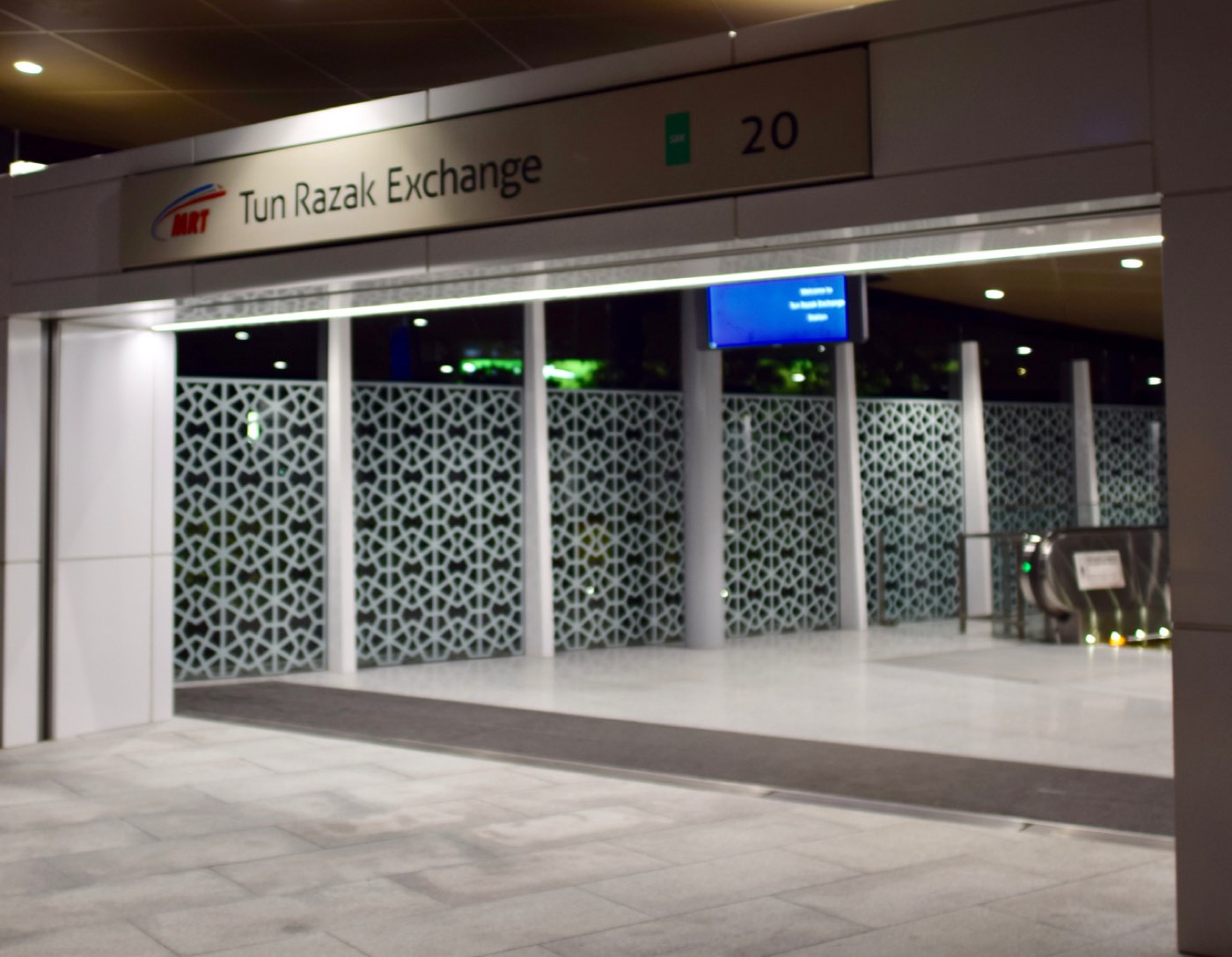
Getting around KL.
The rail works now.
The last time most guidebooks looked properly at Kuala Lumpur’s rail network it did not join up. It does now, end to end, and it is the single biggest practical change to visiting this city since 2019. What has not changed is the pavement, which is where people still come unstuck.
Buy a Touch ’n Go card, use the rail for everything it reaches, and Grab for everything it does not. The network is MRT Kajang and Putrajaya lines, LRT Kelana Jaya and Ampang/Sri Petaling, the KL Monorail, and KTM Komuter out to Batu Caves and Klang — plus LRT3, which added 20 stations in June 2026. It carried a record 1.54 million Prasarana journeys on New Year’s Eve 2025/26. The GOKL city bus is RM1 per ride for foreigners and free for Malaysians. Do not hire a car: foreigners pay RM3.62–3.82 a litre against RM1.99 for MyKad holders. And treat every “near LRT” listing as unproven until you have checked the walk.
The network joins up now, and that is new
Kuala Lumpur spent two decades with rail lines that almost met. The MRT changed that, and the practical effect for a visitor is that you can now plan a whole trip without once thinking about a car.
The MRT Kajang line gave the city a proper cross-town spine through Pasar Seni and Bukit Bintang. The MRT Putrajaya line added a second one and put a station directly under Merdeka 118, which is the single reason the historic south stopped being an afterthought. LRT3 added 20 stations in June 2026. On New Year’s Eve 2025/26 the system carried a record 1.54 million Prasarana journeys in a day — a number that would have been unthinkable on the 2019 network.
What that buys you in practice: Batu Caves for RM2.60 on the KTM Komuter from KL Sentral, Klang and its bak kut teh on the same line, KLIA in 28 minutes on the KLIA Ekspres, and everything in the centre within a ten-minute walk of a platform. There is no visitor itinerary on this site that needs a hire car, and several that are actively worse with one.
One correction to make now, because you will see the claim: MRT3 — the circle line — is approved but does not open until 2032. Every article promising that Mont Kiara or the western suburbs are about to get a train is six years early. Plan for the network that exists.
The one genuine weakness is the last mile, and it is a serious one. See the walking-layer warning below — it is the thing that turns a well-chosen hotel into a daily 25-minute uphill trudge.
Every line a visitor actually uses
Six systems, one Touch ’n Go card. These are the ones that matter for the itineraries on this site.
| System | What it gets you | Use it for |
|---|---|---|
| MRT Kajang line | The cross-town spine: Pasar Seni for Chinatown, Bukit Bintang, Merdeka, out to Kajang. | Day one of any itinerary. Also the line to Kajang for satay at Willy Satay, Jalan Ramal 1, 11:30–23:00, RM1.20–2 a stick. |
| MRT Putrajaya line | The second spine, with a station directly beneath Merdeka 118, and a run south towards Putrajaya. | Merdeka 118 from the ground, and the Putrajaya half-day. |
| LRT Kelana Jaya line | KLCC, KL Sentral, Pasar Seni, Bangsar and the western suburbs. | KLCC for the towers and the fountains, and Bangsar for dinner. |
| LRT Ampang / Sri Petaling | The eastern and southern arms, including Bukit Jalil. | Getting to the stadium end of the city, and hotels sold on the eastern arm. |
| KL Monorail | Bukit Bintang, Imbi, Chow Kit and the middle of the tourist belt. | Bukit Bintang to Chow Kit and back — short hops the MRT does not cover. |
| KTM Komuter | Out of the city proper: Batu Caves one way, Klang and Port Klang the other. | Batu Caves at RM2.60 each way, and Klang for bak kut teh at Seng Huat, 9 Jalan Besar, 07:30–13:00. |
| GOKL city bus | Four looping routes around the centre. RM1 per ride for foreigners since 1 January 2024; free for Malaysians. | Short hops in the rain when the walk is the problem rather than the distance. |
MRT3, the circle line, is approved and opens in 2032. Any guide telling you the western suburbs are about to get a train is describing something six years away.
Four transport rules for Kuala Lumpur
None of these are obvious from a map, and all four cost visitors money or time every day.
This is the single most expensive assumption you can make here. A listing that says near LRT routinely means a 25-minute uphill walk with no continuous pavement, across a slip road, in 32°C. Kuala Lumpur’s rail is good and its walking layer is not — Desa ParkCity is the only place in the city with pavements the whole way, and it is a suburb nobody visits. Open the satellite view and trace the actual route before you book.
Applies especially to Ampang and the Bangsar hillsideMalaysia runs two-tier fuel pricing. MyKad holders pay RM1.99 a litre under BUDI95; you pay the unsubsidised RM3.62–3.82. Roughly double, every tank, plus central parking that is expensive where it exists. Rail and Grab cover everything a visitor needs — see KLIA to the city for the arrival leg.
Two-tier fuel applies at the pump, on every fillYou will read about the My50 pass — RM50 for 30 days of unlimited Rapid KL travel. It is MyKad-only. You cannot buy it as a visitor, and no amount of asking at the counter changes that. Use a Touch ’n Go card and pay per journey; on a normal three-day trip that is well under RM50 anyway. We do not publish other Rapid pass prices because we could not verify them.
MyKad holders only — no visitor equivalent existsFares are low, the app is universal, and it removes the haggling that ruins taxi rides in this city. Use it for the last mile from a station, for Royal Selangor if you miss the free shuttle, and for any journey that ends on a hillside. Street taxis that refuse the meter are a known problem — see KL scams.
Cheaper than the walk is worth in the afternoonKuala Lumpur transport, practically
The transport bookings worth making ahead
Almost nothing here needs pre-booking, which is one of the quiet pleasures of this city. These three are the exceptions.
Getting around Kuala Lumpur FAQ
Is Kuala Lumpur easy to get around without a car?
Yes, and it is one of the best-served cities in Southeast Asia for it now. Two MRT lines, two LRT lines, the monorail, KTM Komuter and LRT3 — which added 20 stations in June 2026 — cover everywhere a visitor goes, and Grab fills the gaps cheaply.
What card do I need for Kuala Lumpur public transport?
A Touch ’n Go card, bought and topped up at any station. It works across every rail system. The My50 pass at RM50 for 30 days of unlimited travel is MyKad-only, so as a visitor you pay per journey — which on a three-day trip comes to less than RM50 anyway.
Is the GOKL bus still free?
Not for you. Since 1 January 2024 the GOKL city bus costs RM1 per ride for foreigners; it remains free for Malaysians. At RM1 it is still the cheapest way to cross the centre, and useful when the walk rather than the distance is the problem.
Should I rent a car in Kuala Lumpur?
No. Foreigners pay RM3.62–3.82 a litre for fuel against RM1.99 for MyKad holders under the BUDI95 scheme, roughly double on every tank, and central parking is expensive where it exists at all. Rail plus Grab is cheaper, faster and less stressful.
How do I get to Batu Caves from Kuala Lumpur?
KTM Komuter from KL Sentral to the end of the line, RM2.60 each way, with the station a two-minute walk from the steps. The Temple Cave is free and open 07:00–21:00. No tour improves on this, which is why we send everybody on the train.
Does “near LRT” mean I can walk to the station?
Often not. It routinely means a 25-minute uphill walk with no continuous pavement, especially in Ampang and on the Bangsar hillside. Desa ParkCity is the only part of Kuala Lumpur with pavements the whole way. Check the satellite view before booking — see where to stay.
When does MRT3 open in Kuala Lumpur?
2032. It is approved, and it is eight years of construction away from carrying anyone. Any guide implying the circle line is imminent, or that Mont Kiara is about to be on the network, is describing something six years out.
Is Grab safe and cheap in Kuala Lumpur?
Yes on both counts, and it is the default for anything the rail does not reach. Fares are low by any international standard, the price is fixed in the app, and it avoids the metered-taxi refusals that are a long-running annoyance here.